Enterprise Analytics Dashboard Redesign
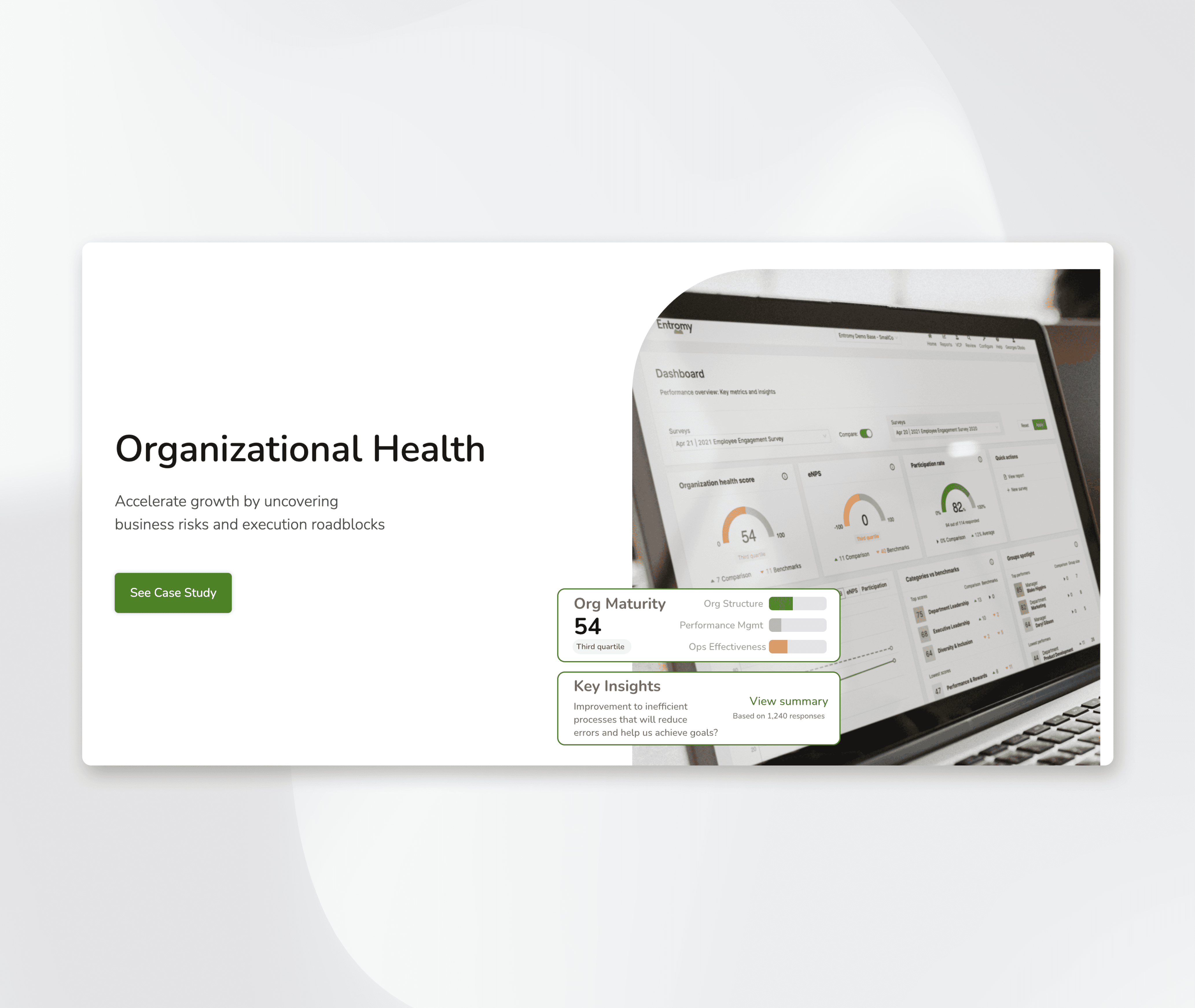
Redesigned Entromy’s core enterprise analytics dashboard, increasing views per user by 41% and session time by 144%.
B2B · +144% user engagement
Project Overview
Role: Product Designer at Entromy.com
Team: 1 product designer, 1 PM, 1 Engineer, 1 QA
Timeline: 2024
Platform: Web
Entromy is a B2B SaaS platform used by private equity and enterprise teams to run organizational health surveys, value creation assessments, and 360º feedback. I worked as the sole Product Designer, owning the end-to-end redesign of a core analytics dashboard used by executive and operational users. Following launch, the redesigned dashboard showed measurable improvements:
41% increase in dashboard views per user
144% increase in average time spent per session
This project is under NDA. Visuals and detailed data are limited; the case focuses on problem framing, design decisions, and outcomes.
Context & Problem
Entromy’s dashboards were used infrequently, often only a few times per year, but during moments of high strategic importance. When users did log in, engagement was shallow: most sessions ended quickly, and deeper engagement with the platform was rarely explored.
Key issues included:
Dense data presentation with unclear hierarchy
Limited guidance on where to focus attention
High cognitive load for first-time or returning users
Missed opportunities to surface actionable insights
The challenge was not to increase usage frequency, but to make each session more valuable and self-explanatory.
Design goal
The goal was to improve clarity, discoverability, and depth of engagement so users could more easily understand results and explore insights without additional guidance from Customer Success.
Key insights
Users needed clear entry points, not more data
Hierarchy and narrative mattered more than visual density
Dashboards should guide interpretation, not just display metrics
Small structural changes could significantly affect engagement behavior
Design approach
I treated the dashboard as a decision-support system, not a reporting surface.
Key decisions included:
Reorganizing information hierarchy to surface the most important insights first
Introducing clearer sectioning and visual grouping to reduce cognitive load
Designing progressive disclosure patterns to encourage deeper exploration
Aligning terminology and structure with how executive users discussed results
Design decisions prioritized clarity and comprehension over novelty or customization.
Solution
The redesigned dashboard focused on:
A clearer top-down narrative, guiding users from high-level signals to detailed breakdowns
Improved visual hierarchy to differentiate primary insights from supporting data
Consistent patterns across sections to reduce relearning effort
Subtle prompts encouraging exploration of deeper insights
While visual details are under NDA, the redesign fundamentally shifted the experience from passive reporting to guided analysis.
Outcomes
Following launch, the redesigned dashboard showed measurable improvements:
41% increase in dashboard views per user
144% increase in average time spent per session
These signals indicated deeper engagement and more thorough exploration of results during each session.
Reflection
This project reinforced that in enterprise analytics, impact often comes from clarity, structure, and narrative, not additional features. By focusing on hierarchy and decision flow, the dashboard became more effective even without increasing usage frequency.
If revisiting the project, I would invest earlier in lightweight usability validation with first-time users and introduce additional instrumentation to better understand which insights drive the most value over time.